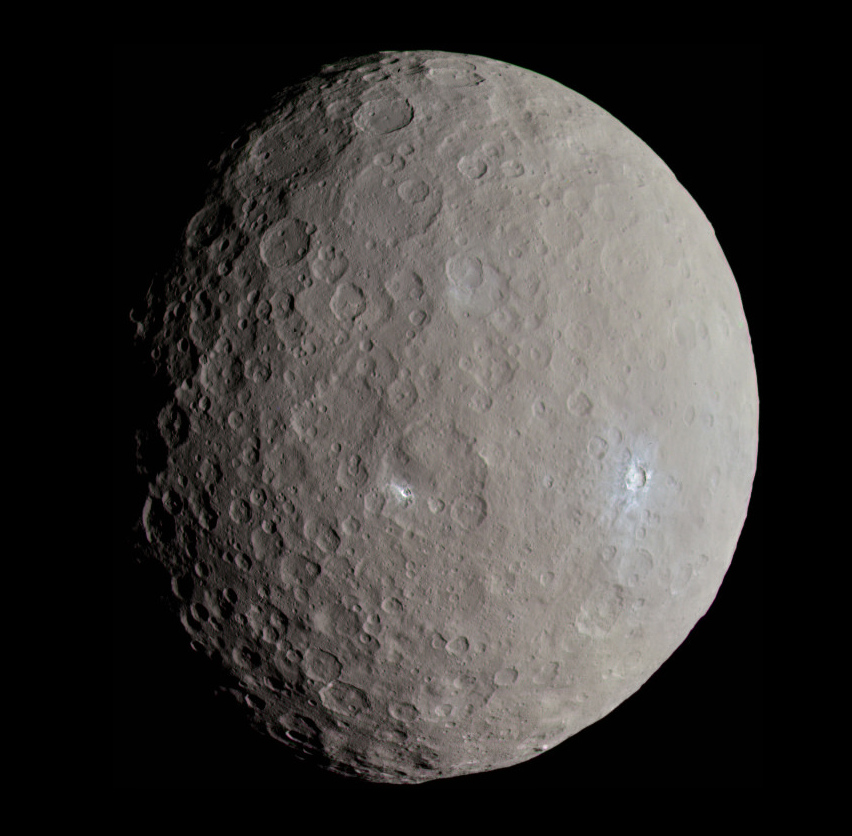
Ceres
Dwarf planet · Asteroid belt
Ceres is the biggest object in the asteroid belt and the only dwarf planet in the inner Solar System. It contains lots of water ice, and bright salty patches show that briny water once reached its surface.
- ~940 kmYou could line up 14 of them across Earth.
- 4.6 yearsYear
- Between Mars and JupiterWhere
Take a closer look
A lonely ice mountain
Dawn found a strange mountain on Ceres called Ahuna Mons, standing about 4 km tall all by itself on a fairly flat plain. Scientists think it is a cryovolcano – a volcano that oozed a cold, salty mud of ice and brine instead of hot lava.
Light as a feather
Gravity on Ceres is only about 3% of Earth’s. A kid who weighs 40 kg at home would feel as light as a bag of sugar there, and a good jump could keep you in the air for a long time. You would still need to be careful not to bounce too far.
Ingredients for life
Dawn’s instruments detected carbon-rich organic material on Ceres’ surface, along with clays and salts that formed in water. Organics are not life, but they are some of the building blocks it uses. That makes Ceres an important place for learning how water worlds form.
Size it up
You could line up 14 of them across Earth. Both are drawn to the same scale.
How we found out
- 1801
On New Year’s Day, Giuseppe Piazzi in Palermo, Italy, discovers Ceres. For about 50 years it was counted as a planet.
- 1801
Ceres gets lost behind the Sun. Young mathematician Carl Friedrich Gauss invents a new method to predict where it will reappear – and he is right.
- 2006
Ceres is reclassified as a dwarf planet.
- 2015
NASA’s Dawn becomes the first spacecraft to orbit a dwarf planet and finds bright spots made of salts in Occator crater.
Could Ceres have an ocean?
There may be pockets of salty liquid water deep beneath its surface – which makes scientists curious about whether it could ever have supported life.
See it yourself
Sometimes visible in binoculars as a faint “star” that shifts position from night to night.
From the encyclopedia
Read the full article on Wikipedia ↗Got it?
Mark Ceres as explored to earn 10 XP.