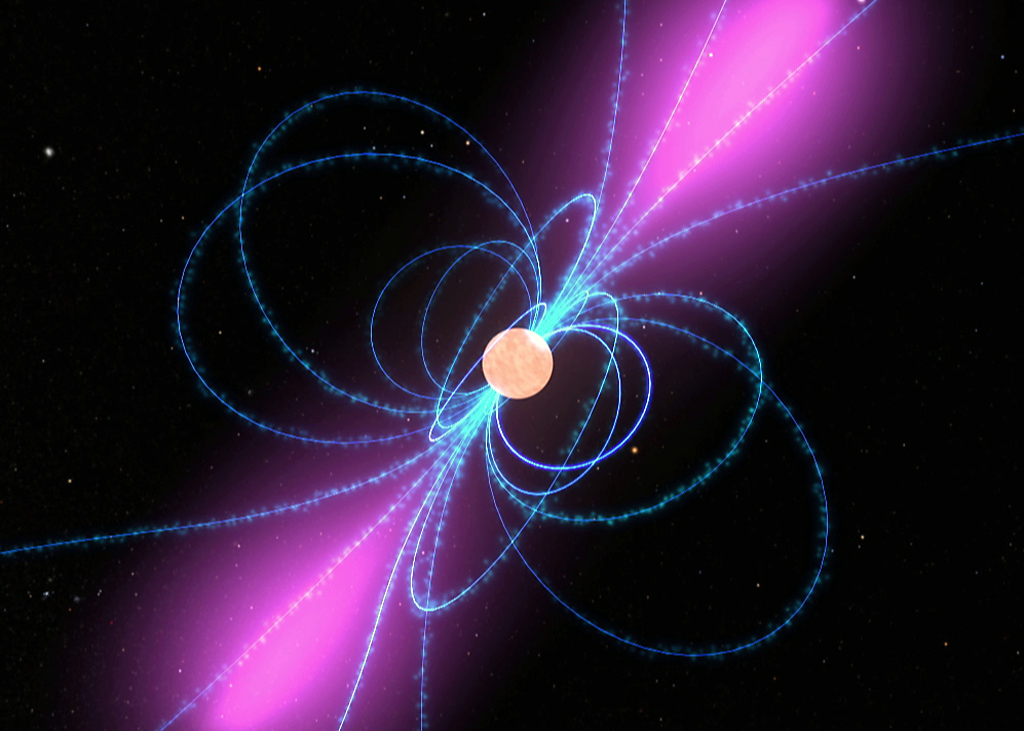
PSR B1919+21 – the first pulsar
Pulsar · Neutron star
This was the first pulsar ever found: a spinning neutron star that sweeps a beam of radio waves across Earth like a lighthouse. Its pulses are so regular that at first scientists wondered whether they were an alien signal.
- 2,300 light-years awayEven light – the fastest thing there is – needs 2,300 years to get here.
- 1.337 secondsPulse every
- 1967Discovered
Take a closer look
A telescope built by hand
The radio telescope that found this pulsar was not a dish but a field of wooden posts and wire, covering more ground than two football pitches. Jocelyn Bell Burnell and other students helped build it. It printed its signals as wiggly lines on long rolls of paper, which she checked by hand.
When beams cross Earth
A pulsar’s beams sweep around as it spins, like a lighthouse. We only see one if a beam happens to cross Earth, so many pulsars are out there that we can never detect. Astronomers have now found more than 3,000.
Clocks across the galaxy
Since 1967, pulsars have become some of the best clocks in the universe. In 1992 the first planets beyond the Solar System were found orbiting a pulsar. In 2023, teams timing dozens of pulsars found evidence of a gentle background “hum” of gravitational waves rippling through space.
How we found out
- 1967
Jocelyn Bell Burnell, a PhD student at Cambridge, spots a strange “bit of scruff” in her radio telescope data. It pulses every 1.337 seconds.
- 1967
Half-jokingly, the signal is nicknamed “LGM-1” – Little Green Men 1.
- 1974
The Nobel Prize for the discovery goes to her supervisor Antony Hewish (and Martin Ryle), not to her – a decision many people consider unfair.
- 2018
Bell Burnell wins a $3 million Breakthrough Prize and donates it all to help students from under-represented groups become physicists.
How can something the size of a city spin once a second?
When a giant star collapses, it spins faster – like an ice skater pulling in their arms – just much, much more extreme.
See it yourself
Only with radio telescopes. But you can point to where it is!
From the encyclopedia
Read the full article on Wikipedia ↗Got it?
Mark PSR B1919+21 – the first pulsar as explored to earn 10 XP.