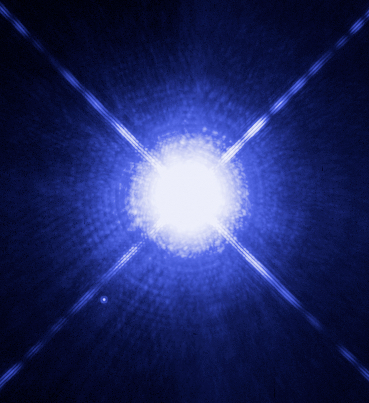
Sirius
Star · White main-sequence (binary)
Sirius, the “Dog Star”, is the brightest star in the night sky. It shines so brightly because it is both powerful (about 25 times brighter than the Sun) and close. It has a tiny companion: a white dwarf called Sirius B.
- 8.6 light-years awayEven light – the fastest thing there is – needs 8.6 years to get here.
- Brightest star at nightBrightness
- 2 × SunMass
Take a closer look
A hot white star
Sirius looks white because it is much hotter than our Sun: its surface is close to 10,000 °C, while the Sun’s is about 5,500 °C. It is also nearly twice as wide as the Sun. Hot stars like this use up their fuel much faster than the Sun does.
A 50-year dance
Sirius and its tiny partner, Sirius B, circle each other once every 50 years. Sirius B used to be the bigger star, but it aged faster, swelled up and blew away its outer layers, leaving only its hot core. One day Sirius itself will end the same way.
The dog days
In ancient Greece and Rome, Sirius rose with the Sun in the hottest weeks of summer. People thought the Dog Star added its heat to the Sun’s, so they called that stretch of summer the “dog days” – a name some people still use today.
How we found out
- Ancient Egypt
The first appearance of Sirius before dawn each year warned Egyptians that the Nile flood was coming.
- 1844
Friedrich Bessel notices Sirius wobbling and predicts an invisible companion.
- 1862
Alvan Graham Clark spots the companion, Sirius B, while testing a new telescope lens.
Why do stars twinkle?
Their light passes through moving layers of Earth’s air that bend it slightly this way and that. Bright stars near the horizon twinkle the most – Sirius often flashes colours!
See it yourself
Follow the three stars of Orion’s belt downwards to the left – the dazzling star you reach is Sirius.
From the encyclopedia
Read the full article on Wikipedia ↗Got it?
Mark Sirius as explored to earn 10 XP.