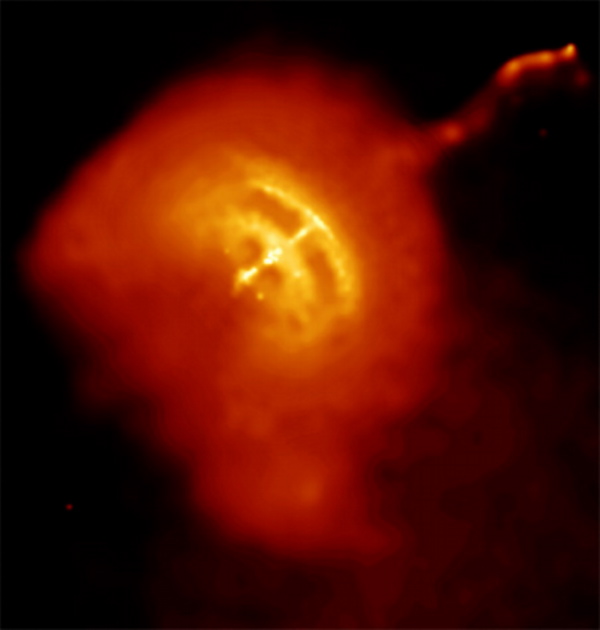
Vela Pulsar
Pulsar · Neutron star
The Vela Pulsar is the collapsed core of a star that exploded about 11,000 years ago. It is one of the brightest sources of gamma rays in the sky, and sometimes it suddenly spins a little faster – a “glitch”.
- 950 light-years awayEven light – the fastest thing there is – needs 950 years to get here.
- ~11 times per secondSpins
- ~11,000 yearsAge
Take a closer look
A giant sky ghost
The cloud left by Vela’s explosion is enormous on our sky – about 16 full Moons wide. It is far too faint to see by eye, but long-exposure photos show a huge web of glowing threads. The pulsar sits inside it, slowly drifting through the wreckage.
The firehose jet
The Chandra X-ray telescope filmed a jet of particles shooting out of the Vela Pulsar. Over months it whips and wriggles from side to side, like a firehose that someone has let go of. Watching it helps scientists understand how pulsars fling energy into space.
Faint flashes of light
Although Vela is bright in radio waves and gamma rays, its visible light is incredibly faint. In 1977 astronomers in Australia finally caught it flashing in visible light, 11 times a second.
How we found out
- 1968
Australian astronomers at the Molonglo radio telescope discover it inside the Vela supernova remnant.
- 1968
Together with the Crab Pulsar, it proves that pulsars are born in supernova explosions.
- Since then
Scientists study its glitches to learn about the weird matter inside neutron stars.
Why would a spinning star suddenly speed up?
Scientists think the neutron star’s interior is partly a “superfluid” that occasionally transfers spin to the crust all at once.
See it yourself
Southern sky, in the constellation Vela (the Sails). Radio and gamma-ray telescopes only.
From the encyclopedia
Read the full article on Wikipedia ↗Got it?
Mark Vela Pulsar as explored to earn 10 XP.