Mercury
Planet · Rocky
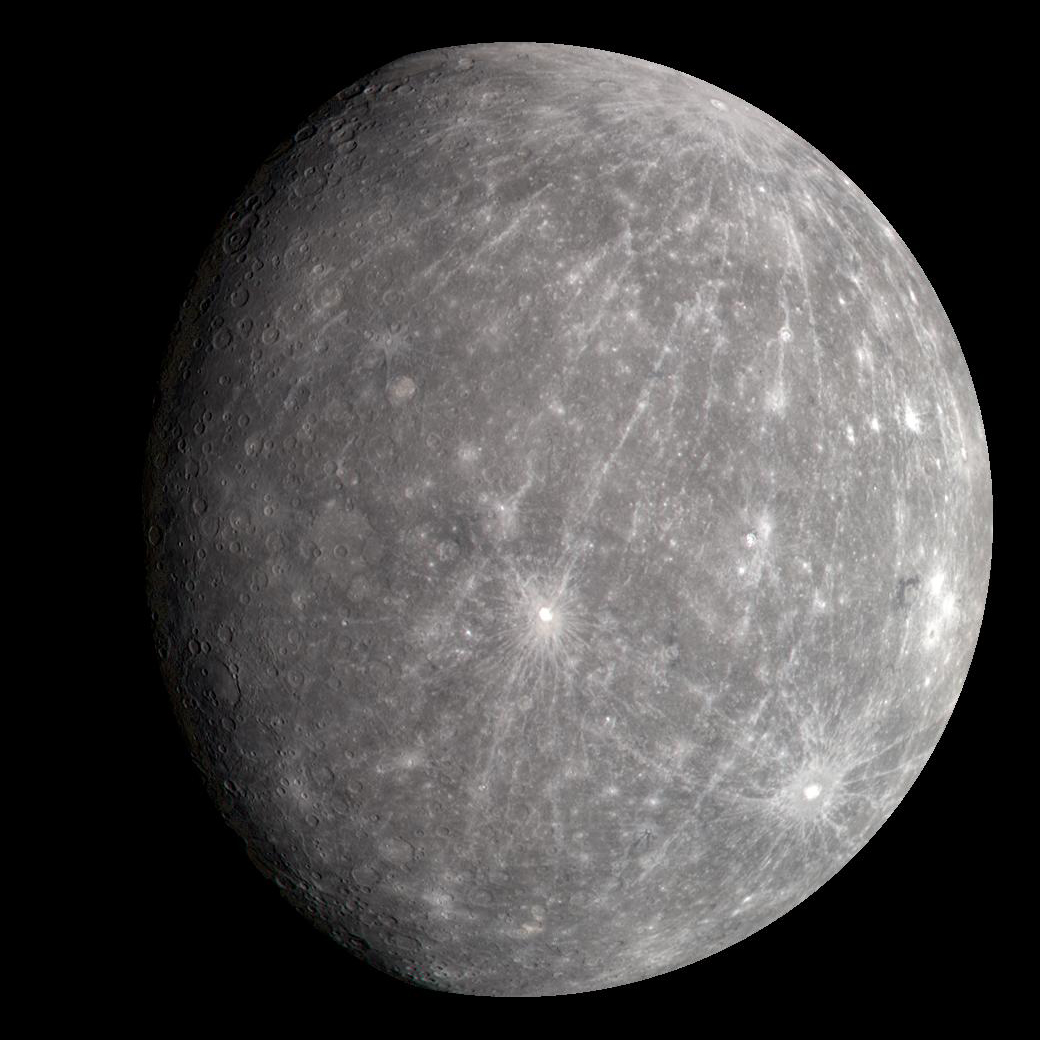
Mercury is the smallest planet and the closest to the Sun. With almost no air to hold heat, its days are hot enough to melt lead and its nights are colder than Antarctica.
- 4,879 kmYou could line up 3 of them across Earth.
- 88 daysYear
- −180 °C to 430 °CTemperature
Take a closer look
A giant iron heart
Mercury is mostly metal inside. Its iron core stretches across about 85% of the planet’s width, like a peach with a stone so big there is hardly any fruit left. That makes little Mercury the second-densest planet, after Earth.
A shrinking planet
As Mercury’s huge core slowly cooled over billions of years, the whole planet shrank. Its rocky skin wrinkled like the peel of a drying apple, creating long cliffs that run for hundreds of kilometres and rise more than a kilometre high. Scientists spotted these wrinkles in spacecraft photos.
A giant Sun overhead
If you stood on Mercury, the Sun would look two to three times wider than it does from Earth, blazing in a pitch-black sky. Reaching Mercury is surprisingly hard: spacecraft speed up as they fall towards the Sun, so they need years of looping fly-bys to slow down enough to stay.
Size it up
You could line up 3 of them across Earth. Both are drawn to the same scale.
How we found out
- Ancient times
Known to the Sumerians and Babylonians. The Romans named it after their fast messenger god, because it moves quickly across the sky.
- 1631
Pierre Gassendi watches Mercury cross in front of the Sun, as Johannes Kepler predicted.
- 1974
Mariner 10 becomes the first spacecraft to fly past Mercury.
- 2011
MESSENGER goes into orbit and finds water ice hidden in craters at the poles that never see sunlight.
- 2026
The European–Japanese mission BepiColombo is due to arrive in orbit around Mercury.
How can there be ice on the planet closest to the Sun?
Some craters at Mercury’s poles are so deep that sunlight never reaches their floors. They stay colder than −170 °C forever.
See it yourself
Low in the sky just after sunset or just before sunrise, a few times a year. It never strays far from the Sun.
From the encyclopedia
Read the full article on Wikipedia ↗Got it?
Mark Mercury as explored to earn 10 XP.