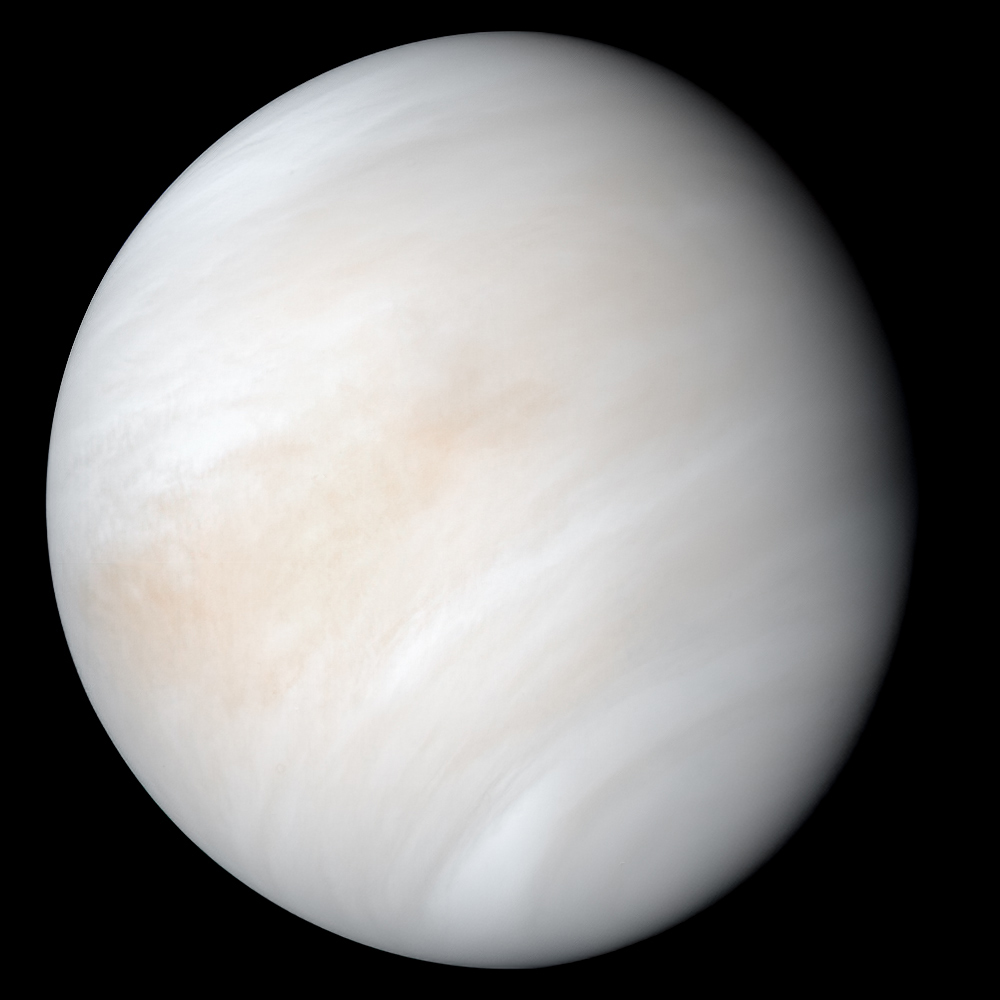
Venus
Planet · Rocky
Venus is almost Earth’s twin in size, but it is a nightmare world: its thick carbon-dioxide air traps heat so well that it is the hottest planet, and its clouds are made of sulfuric acid. It also spins backwards compared to most planets.
- 12,104 kmAlmost exactly the same size as Earth!
- ~465 °CSurface
- 225 daysYear
Take a closer look
Crushing air pressure
The air on Venus is so thick that standing on the surface would feel like being nearly a kilometre deep in Earth’s ocean – about 90 times the pressure we live in. The Soviet Venera landers that reached the ground survived for two hours at most before the heat and pressure destroyed them.
Seeing through clouds
No camera can see Venus’ surface from space because the clouds never part. Instead, spacecraft like NASA’s Magellan used radar, bouncing radio waves off the ground to map it. They revealed a world covered in lava plains and more large volcanoes than any other planet.
Racing clouds
Venus itself turns incredibly slowly, but its upper clouds whip around the whole planet in only about four Earth days. Their winds reach around 360 km/h – faster than the strongest hurricanes on Earth. Scientists call this “super-rotation”, and they are still working out exactly what powers it.
Size it up
Almost exactly the same size as Earth! Both are drawn to the same scale.
How we found out
- ~1600 BC
Babylonian astronomers record Venus’ appearances on the “Venus tablet of Ammisaduqa”.
- 1610
Galileo sees Venus go through phases like the Moon – evidence that it orbits the Sun.
- 1769
Expeditions around the world, including James Cook’s, time Venus crossing the Sun to measure the size of the Solar System.
- 1962
Mariner 2 becomes the first spacecraft to successfully fly past another planet.
- 1970
The Soviet Venera 7 makes the first landing on another planet that sends back data.
Venus is further from the Sun than Mercury. Why is it hotter?
Its thick atmosphere acts like a blanket – a runaway greenhouse effect – trapping the Sun’s heat.
See it yourself
The brightest thing in the night sky after the Moon. Look for a brilliant “evening star” after sunset or “morning star” before dawn.
From the encyclopedia
Read the full article on Wikipedia ↗Got it?
Mark Venus as explored to earn 10 XP.